*JULY 7-14 were the dates for the 2012 AWARE clean-up of the Iowa River. Please see the 2012 post for results: http://strip-n-twitch.blogspot.com/2012/07/this-year-participants-in-iowa-dnrs_19.html *
 On July 9-16, 2011, the Iowa DNR again backed up its trash talk with action. The DNR’s Project AWARE volunteer river clean-up of the Little Turkey, Turkey, and Volga Rivers netted 64,722lbs of garbage. That is the equivalent of 32.36 tons, or nearly the weight of 18.5 new 4WD Honda CR-V LX SUV’s, being removed by volunteers and their canoes!

This year, 429 volunteers participated in the clean-up. An average of 152 volunteers participated each day with 273 being new to AWARE this year and 61 having participated for 5 or more years. Of the total amount of trash collected by these volunteers, 96% was recycled. Scrap metal, then tires (611), composed the greatest weight of recyclables, and 335lbs of redeemable cans/bottles (cha-ching!) were found. 

Participants ranged from aged 2 to 76. An Indiana father/daughter team participated and a father from Cedar Rapids, IA., had sons from Illinois, Colorado, and Oregon join him on the hunt for garbage.
When asked what the most unusual piece of trash removed from a river was, Brian Soenen, Project AWARE Coordinator replied, “While I don’t recall anything being incredibly unique, volunteers found quite a few wooden-spoked wagon wheels and an insane number of large implement tires. The great news is that most of the trash was ‘old’ junk…been there a long time and has now been forever removed.”
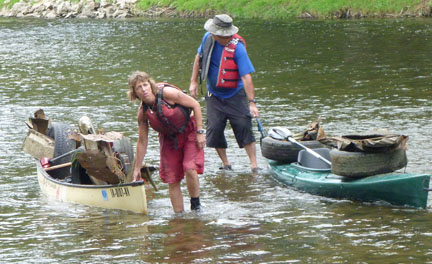
When asked what the most unusual piece of trash removed from a river was, Brian Soenen, Project AWARE Coordinator replied, “While I don’t recall anything being incredibly unique, volunteers found quite a few wooden-spoked wagon wheels and an insane number of large implement tires. The great news is that most of the trash was ‘old’ junk…been there a long time and has now been forever removed.”
Photo Caption Information:
 #4: Members of the Dubuque Fly Fishers and the Hawkeye Fly Fishing Association were asked to volunteer their time and present a hands-on fly casting clinic. Approximately 8 fly anglers participated. Project AWARE volunteer Rose Danaher, Homestead, IA, (pictured) receives a fly casting lesson from Kate Lodge, a member of both clubs, & a Geneseo, IL, resident.
#1: On day 1, Nick Gaeta, Cedar Rapids, IA, transports trash through Gouldsburg Park on the Little Turkey River, following a 'pre-cleanup' of nearby Crane Creek. Gaeta has participated in all but the 1st year of the Project AWARE clean-ups. #2: While at least 5 paddlers had already spent a good portion of this day plucking trash on a 'pre-cleanup' of Crane Creek, most volunteers set up camp at Gouldsburg Park, Hawkeye, IA, & enjoy the day's outdoor festivities. The confluence of Crane Creek and the Little Turkey River is located at the park. #3: KJ Rebarcak, Long Grove, IA, left, and 'Dutch Oven' Dave Brown, Springfield, MO, transport trash through the Little Turkey River on the first day of this year’s Project AWARE river clean-up. The trash was actually removed from nearby Crane Creek.
 #4: Members of the Dubuque Fly Fishers and the Hawkeye Fly Fishing Association were asked to volunteer their time and present a hands-on fly casting clinic. Approximately 8 fly anglers participated. Project AWARE volunteer Rose Danaher, Homestead, IA, (pictured) receives a fly casting lesson from Kate Lodge, a member of both clubs, & a Geneseo, IL, resident.
 For more information about Project AWARE (A Watershed Awareness River Expedition), & methods of participating in the clean-up of Iowa waterways, please visit this link: http://www.iowadnr.gov/Recreation/CanoeingKayaking/ProjectAWARE.aspx . And, please e-mail me your 'trash talk'! If you pick up trash from waterways or want to share how you have changed your own habits of trash disposal while on waterways, if you want to comment about how waterways have improved over the years, or if you want to report about what you most commonly find in and along waterways, email me about it or send me a picture. I'd like to increase the attention paid to the maintenance and appreciation of our waterways. ~Twitch


