Friday, July 26, 2013

Smallie Tangles with Fluffy Butt on Upper Iowa River Float

   The red-eyed, black Fluffy Butt splatted on the water in a break between the trees.  A split-second later & at least 3’ away, a largish, olive-colored fish leapt into the air.  Oh baby!
  
   I finned furiously to maintain my pontoon’s position in the brisk current of the Upper Iowa River.  Gaining in excitement, I soon cast my fly into the tree branches located above the fish’s lair.  Feeling the urgency that I’m certain other anglers would understand, I attempted to tease that fly from the wood.  Failing to delicately gain its release, I pinched fly line in my fingers & let tension steadily build on leader and fly by allowing the pontoon to drift downriver.  Then, at one point, the fly line simply relaxed.  Looking down & lifting the rod tip, I didn’t see the expected limp, dangling leader.  My Fluffy Butt emerged from the river, still connected solidly to its tippet.
  
   The pontoon had drifted downriver from the bank with the overhanging trees.  With the old iron bridge of my take-out spot already in view & the hot July sun again meeting my skin, I decided to finish out the float.  But in the next second, I sensed my regret if I should give up so quickly on landing what was no slouch of a fish.  The river, which meanders through Decorah, IA, before making its way to the Mississippi River, had suffered through 2 drought years followed by multiple floods in 2013.  The water remained higher than usual and turbid.  After 6 hours of fishing, I’d landed one 7” smallie & missed 2 strikes.  Others had admitted to taking no fish, aside from one guy who kept saying he’d “cheated” and put on a worm, telling me he then landed a small fish.  At least the reports of the river’s beautiful scenery were true.    
  
   So, I rowed my pontoon upriver & continued past the fish’s lair at least another 25’ to ensure there was time to prepare fly rod and line for casting.  Once again, I furiously waggled my finned feet to hold the toon’s position.  The casts advertised my excitement, but I avoided casting into any more trees.  I talked to the fly, I talked to myself, and I talked to the fish.  Please, oh please.
  
   And on my 5th or 6th drift, someone or something listened…   That fish took my Fluffy Butt, made the shortest of runs & vaulted from the water!  I yelled, “Whooop!!”, among other things.  Ecstatic, I could not believe my good fortune.  That powerful smallie and I fought through its runs, dives, & aerial acrobatics for about 4 minutes.  The fish needed to expend a bit of energy prior to any attempt for me to lip it from on my toon & I was determined not to break it off. 


“If I land this fish will you take a picture?” I asked the man in the kayak.  Just about the time I hooked into the smallie, I’d glimpsed the couple floating down the river in their kayaks.  The man had evidently taken more interest in the fishy antics and remained closer to the action.  With the smallie lipped, we jockeyed our watercraft to maintain close contact and I handed him the camera.  Feeling happy and filled with life, I held that 16.5” smallmouth, complete with red-eyed, black Fluffy Butt adorning its lip.  The next moment I thanked the couple, & retrieved my camera & fly.  After ensuring the fish was doing well, I released it.  In a flash the smallie returned to its turbid waterworld.  Thanks, oh thanks.


IF You Go
   The Upper Iowa River flows through MN and IA in its upper stretch & angling in this region requires fishing licenses from both states.  In Iowa, the river is deemed ‘navigable’ so the public may float its waters.  However the river is also classified ‘non-meandered’, meaning the owner(s) of the land adjacent to the water also own the stream bed.  If this is a private owner, the riverbed is also private property.  While the public can legally float the river, there are limited circumstances in which the public can legally step foot on privately-owned riverbed (likely such as wading through or around obstacles of water navigation).  Please visit the internet or a DNR office in the region for more details. 
  
   The water varies from skinny to wide as it flows downriver through Northeast Iowa.  The river’s popular rocky bluffs, shores and river bed are interspersed with a wooded, dirt, sand &/or farm landscape.  Easily navigable rapids are replaced by a more placid current flow.  Four dams are present along the river’s length & must be portaged.  Skinny water can mean shallow water where a canoe will need to be dragged.  Bigger water may increase the need for a PFD, but one per person is required on all watercraft in Iowa.  This link is recommended to learn current, average & historic water flows and depths for particular waterways:  http://waterdata.usgs.gov/ia/nwis/rt
  
   Smallmouth bass are more prevalent in the river’s upper, rocky, often shallow habitat but both smallies and walleye are found throughout the river.  Walleye, as 2” fingerlings, are also stocked in the river and both walleye and sauger travel upward from the Mississippi River.  Pike are also sprinkled throughout the Upper Iowa River.  Trout can be found near coldwater tributaries and springs.
  
   It is reported that the greatest recreational traffic is often found near Kendalville to Bluffton and on to Decorah due to the combination of beautiful scenery coupled with fewer river sections requiring the possibility of dragging watercraft through shallow water.  Of course more recreational traffic can affect fishing.
  
   Multiple campgrounds are located on the Upper Iowa River and an easy put-in or takeout spot is an excellent benefit to staying at one of the campgrounds.  Luckily, I    found a quiet, uncrowded campground.  I wasn’t thrilled with the $2 fee to shower or the $20 shuttle service (to take me on a 10-minute drive back to my vehicle), but it was convenient.  I drove by two crowded campgrounds located across the river from one another.  On a Friday at nightfall, I heard blaring country music and the ka-booms M-80s.  The tightly-packed metal campers reminded me of sardines in a can.  The campgrounds might be a fun place to party.  Those who were awake as I floated between the campgrounds on Saturday morning waved & were friendly as was, literally, everyone else floating the river that day.  Again, I recommend an internet search for reviews on campgrounds (or local outfitters for watercraft or shuttle rentals), to ensure your needs for the type of trip you want are met.  Of course, Iowa also offers many Wildlife Management Areas (WMA) if you don’t mind primitive camping.
  
   DNR employees, campground operators, river outfitters & fishing guides are also potential sources of great information to make a successful fishing and float trip.  DNR offices, including hatcheries and rearing stations, are some of the businesses which offer canoe float maps of Iowa rivers.  The maps are an excellent resource for planning a successful float trip.  I’ve read positive reviews about the book “Paddling Iowa”, by Nate Hoogeveen, & will soon own a copy of the 2012 revised edition. (7/2013)


Saturday, May 11, 2013

Annual Fly Casting Clinic in Bettendorf Hosted by K&K and St. Croix Rod Rep

  
   The annual K&K Fly Casting Clinic was held May 11, 2013, at Middle Park Lagoon, in Bettendorf, IA.  Dan Johnston, a St Croix Rod rep, Cedar Rapids, and Erik Mattley, a former K&K Hardware employee, were the fly casting instructors.  Approximately 20 people, either wishing to hone their casting skills or picking up a fly rod for the first time, attended the clinic.  Dan provided St. Croix rods and the Hawkeye Fly Fishing Club provided additional rods for those who didn't have their own with which to practice.  K&K Hardware provided lunch.

   Aside from Dan's classically excellent demonstrations of  fly casting techniques & one-on-one casting instruction, he also provided basic information on stringing up the fly rod, how to safely separate stubborn rod sections, and how fly line loads the rod & carries the fly to its intended (hopefully!) destination.

  
The casting clinic has been held yearly on the Saturday prior to Mother's Day.  Classically, another volunteer provides attendees with fresh breakfast made on the outdoor grill, then beginning fly casting instruction commences, followed with lunch, and then the instruction of the advancement of casting skills rounds out the day.

   To learn more about fly fishing including casting, tying flies, or where to fish, visit your local fly fishing club, fly fishing shop, or, perhaps, an outdoor store. In the Quad Cities region, please visit the link to the local branch of the HFFA's website for contact information and please note that all are welcome to attend meetings or club outings.  For more information, you may also send 'Twitch' an email at stripntwitch@yahoo.com .  Finally, K&K Hardware, Bettendorf, IA, offers fly tying supplies and fly fishing rods/tackle.

Links


Saturday, May 4, 2013

AQUAPAC WET & DRY BACKPACK: In-Depth Description & Review


   The Aquapac Wet & Dry Backpack was used in March 2013 on a rainy fly fishing weekend with snow still on the ground.  Also wearing layers for warmth, we hiked along trails and through streams, & ‘bushwhacked’ through the woods.  During the light rain and after setting it in the snow, the backpack remained waterproof & comfortable.  I’ve used the backpack on other fishing/wading trips but no rain or snow was present.  Later, I ‘water-tested’ the backpack at home and the results are posted below.  (11/27/13: Additional updates and comments provided near end of post) (3/17/14: final update on product changes/improvements and customer service provided near end of post)

FACTS
   This waterproof, IPX6 rated (*1), backpack is made of a TPU-coated fabric with taped seams and has a 25 liter capacity.  Lying flat, it measures approximately 15”W x 26”L.  There are 3 inner compartments to this backpack. The backpack itself creates the largest compartment and it contains an attached, pull-out, inner fluorescent-colored pouch, of similar length to the backpack. This Velcro-sealed pouch has a smaller, clear, velcro pocket fully attached to the pouch’s outer wall.  The fluorescent pouch is water-resistant since the Velcro does not seal fully on the left and right edges. The clear pocket Is water-resistant but not designed to be waterproof.  It is a good location to stowe keys, cell phone, etc.

   The exterior of the backpack has a ~14” long mesh pocket on the left and right sides.  These pockets can hold a thermos, a packable rain jacket, tripod, or a fly rod tube, etc.  There is a small, rear, Velcro closure compartment that contains a ‘back support’, which is a 1/4” thick flexible pad.  It can be removed from the backpack and used as a light seat pad.  This rear compartment could also be used to house a small hydration pack (1.5L to possibly 2L size) when the pad is removed.
The backpack is predominantly black with a small, fluorescent orange overlay, the blue Aquapac logo, and a lashtab with a carabiner.  The adjustable shoulder straps are lightly-padded mesh.  A covering over the mesh allows one to add more carabiners.  There is a sternal strap, adjustable in snugness of fit, and it can also be moved up and down.  An adjustable, unpadded waist strap is present and can be removed.

FIT
   The backpack appears designed to optimally fit the average-sized man.  When layered, including waders, for our weekend of fly fishing in winter weather, friend Kate and I took turns wearing the pack and found it to adequately fit each of our body types.  I’m 5’7” & wear sm-med tops while Kate is 5’3” and much more curvy ‘upstairs’ than me (Later, my 6’2” friend, Scott, donned the backpack over a shirt and the fully extended sternal strap clicked in place over his broad chest.).  With all the straps tightened appropriately, the pack held firmly to the back.  It didn’t seem too long for our body styles.  At home, when I fit the backpack over a sweatshirt, I had to fully tighten all the straps to achieve a snug fit.  The dangling portions of the tightened shoulder straps hung down at least 2 feet, necessitating that I wrap them around themselves. 

   The up and down adjustment of the sternal straps accommodated a woman’s shape but also allowed access to the large chest pockets on my wading jacket.  The shoulder straps were comfortable on our trip, but the clothing layers added extra padding.  For a quick trip, simply throwing one strap over my shoulder was comfy, forming naturally to my body.

   It is not necessary to use the waist strap, but it may contribute to an improved ergonomic fit.  On my 2nd outing with the backpack, this strap wasn’t used and I was comfortable & did not experience excessive pack movement.  The waist buckles extend a fixed 3” from their attachment points on the backpack.  The waist strap is adjustable in length and clips to the buckles.  Kate and I both found it challenging to clip and unclip the buckles during each of our turns to wear the backpack.  I helped Kate with a waist strap buckle because she could not adequately reach it.  The 3” buckle length is simply not adequate when wearing bulky clothing or for use on a less flexible person.

THOUGHTS on FUNCTIONALITY
   Overall, the pack serves its purpose quite well.  It is a very good day pack for hiking or fishing and would also work well with other pack items on a multi-day float trip.  The main closure seals like a dry bag and the backpack remains waterproof. Due largely to the style of closure, it is not rated by Aquapac for submersion.  To clarify an element of the backpack’s use, An Aquapac representative answered my question about float trips, “Any roll-top dry bag is limited by how well the user closes it. Folds must be crisp and tight, with nothing trapped in them.  If that’s the case, then the backpack will be fine in the sloshing water of your canoe.” (**See March, 2014,  update below, re: waterproof & canoe trips**)

   The interior is especially nice.  Having 2 large pockets, with one brightly colored,
allows one to separate wet/dry clothing or clean/dirty items and to see items more readily than with an all-black interior.  The 3rd pouch, small and clear, is one of my favorite features.  I truly appreciated knowing my key fob was dry and that I had easy access to it.

   If I thought a day would turn hot and sunny, I’d consider using something else when hiking, largely due to the pack’s primarily black color and the lack of any ventilation between pack and back. 

   They aren't perfect, but I really like the exterior, full length mesh pockets.  In rainy/wet conditions, the mesh does not hold water and dries quickly.  However, the mesh did allow cockleburs to attach themselves to the pockets.  The elongated pockets easily held a fly rod tube & a thermos – a huge plus for the cold-weather fly angler!  A typical water bottle sits low in the pocket and it’s not practical to remove the bottle while still wearing the pack.  This is an inconvenience, but more importantly there is little chance of bending over and having a water bottle unknowingly fall out of the pocket.  I wish there was a single, shorter pocket sandwiched over one of the longer pockets to give one the choice of easily accessing a water bottle.

   At most, the ‘back support’ provides very light stabilization to the back (remember, this is for a day backpack) but I definitely appreciate the padding it provides between the pack’s contents and one’s back.  It’s also advantageous that the support is removable for quick drying or to add a hydration pack.     

   I found the shoulder straps to be comfortable and to offer adequate padding to serve
the pack’s intended purposes while keeping it lightweight and quick drying.  The sternal strap adjusted well for snugness, and each half conveniently adjusted up and down along the shoulder straps.  Again, the buckles of the waist strap are too close to the bag which will make it challenging for some to attach/detach this strap, but I don’t feel it’s necessary to use it.  Because I had to wrap some of the dangling straps around their snug counterparts and due to the location of the waist strap buckles, it did take me longer to remove the pack.  While I don’t wish for Aquapac to make different sizes of wet/dry backpacks, I do wish they made packs that came in two different sets of strap lengths to better fit a wider range of body types. 

INFORMAL HOME WATERPROOF TESTS
1)  I put clothing in the backpack and placed the backpack in a small sink containing ~ 4 inches of water.  After 30 minutes the clothing and the backpack’s interior remained dry.  This could represent the backpack sitting in shallow water on the bottom of a canoe.
2)  I flipped the fluorescent interior pouch to the outside of the backpack and then both dunked that pouch and sprayed it and its clear pocket (avoiding their closures) with water.  Their interiors remained dry.  Wet clothing would not affect dry clothing stored in the other pouch & keys would remain dry in the small pocket.
3)  I repeated the first test, packing the backpack with clothing and planning to leave it sitting in water for 1-2 hours.  I’d removed the ‘back support’, put 4-5 inches of water in the sink, & added the backpack.  After 20 minutes I checked on the pack and saw much of the water had drained from the sink.  I checked the backpack’s interior and found moisture at the lower rear section.
4)  The next day, I used the high pressure selection on the garden hose sprayer and & gave the pack a good hosing for a couple of minutes –to represent my home-version of an IPX6 ratings test.  I had not replaced the ‘back support’.  The backpack’s interior again became damp at the rear bottom.  So, I turned the pack insideout, set it in the sink and added water.  Primarily, dots of water appeared right on the bottom rear seam of the backpack, despite that the seams had been taped.  This seam is also the seam for the base of the ‘back support’ pocket. 
 * In August 2013, I followed-up with Aquapac about the waterproofing concerns.  Please see the final paragraph in the 'Verdict' section below for details.

PROS
Rated IPX6 waterproof, with no zippers to fail.  Multiple interior compartments with ample space for day trip.  Decent fit.  2 long, exterior, mesh pockets won’t hold rainwater but will hold water bottles, a tripod, or thermos.  Can be used with small hydration pack.  Can attach carabiners.  Lightweight & packs down fairly small when not in use.  No PVC in backpack & it remains pliable in cold weather.  Backpack color blends with environment.  Quick company response to emails and an excellent warranty/return policy.

CONS
Waterproof but not submersible due to closure style, & sample backpack did not ‘pass’ home waterproof tests.  Dangling portions of tightened straps are too long for certain body types & waist buckle attachments are short.  Long lengths of exterior mesh pockets make it difficult to access a water bottle while wearing the backpack.  The backpack is black and would make the wearer or pack contents hotter if the day became hot & sunny.

VERDICT
   Would I recommend the Aquapac Wet & Dry Backpack?  During online comparisons of other waterproof backpacks of similar size, the Aquapac seems to be a good bang for the buck & the warranty is great!  Communication with Aquapac staff was prompt and they gave me the impression they really take pride in their products.  This backpack is appropriately simple in its design yet it contains excellent, practical features.  Specific to the fly angler, features on the backpack would make it ideal to:  stow in a canoe for a day float trip; for quick & secure thermos access during winter steelheading; and to carry fly rod tubes during night fishing for salmon.  If the sample backpack had passed my home waterproof tests, I would’ve heartily recommended this waterproof backpack.

   In my opinion, the greatest value of Aquapac's backpack lies in the claim that it is IPX6 waterproof-rated.  My hope is that I simply received a flawed backpack.  If this is not the case, I could not recommend the backpack based on its cost in relation to its limited scope of use in the outdoors.  Again, Aquapac appears to stand behind its products.  I intend to send pictures of the home waterproof test findings to Aquapac.  If there are any information updates or changes to their backpacks, as appropriate I will update my post or write a new backpack review.  
   * August 23, 2013:  After I sent pictures to Tim Turnbull, CEO, in May I was asked to return the backpack for testing.  Not having received further correspondence, yesterday I emailed Mr. Turnbull & reminded him that I would update my post if they had made any changes to the product, etc.  I had a reply sitting in my inbox this morning.  I haven't received another backpack for testing to personally confirm Aquapac's findings, but Mr. Turnbull's response is quoted here:  Hi Lisa. Sorry if nobody got back to you. I checked and this was the answer from the Director who looked into it: “Yes, the sample returned had defective seam-sealing at the base of the bag and on part of the back-protector pocket, where water under pressure was seeping through. We’ve flagged it as a QC problem with the factory and they have said that they’ll pay more attention to it. It was human error. We've tested some random samples by hosepipe and filling with water and I’m happy that it was an isolated or low-volume problem.”  
   *November 27, 2013:  In October I purchased another Aquapac.  Great sale price, so if it performed like the others, I figured it still wasn't a bad deal.  I'm glad I bought it on sale.  While I didn't test this backpack as thoroughly, it also leaked.  I placed it in water similarly to how it might sit in a canoe.  At a minimum, this one also leaked at the region of the back-protector seams.  About 3 tablespoons of water entered the interior of the pack in 15-30 minutes.  I plan to use it in snow or rain but would be cautious in a heavy rain.  On a positive note, the yellow-green pocket remained waterproof when briefly submerged in water to just below its opening. However, the small, clear pocket where a cell phone and key fob would likely be stowed did have leakage from a bottom seam.
   *March 17, 2013:  I got around to letting Aquapac know that this pack leaked, too.  Again, they wanted me to return it.  I opted to use their normal warranty claim process.  I was very pleased. I sent an email and received a response with an RMA number the next day.  It cost me ~$6 via USPS to return it rolled up in a small box.  I received my new pack in less than 1 week from initial contact. Excellent customer service!
   Yesterday I water-tested it. I simply put some weight in the backpack and placed it in a bucket filled with water.  The exterior was about 50% immersed for 5 minutes.  No leaks.  I then sprayed it thoroughly with the shower head.  No leaks/damp spots.  I then submerged it to about 30% from the top for 15 more minutes.  No leaks and heavy beading to the exterior!  Finally I unzipped (Unzipped? Yes, this is a recent change to the Wet and Dry Backpack) the yellow inner pouch from the backpack and submerged the pouch until only the upper 30% remained dry.  Yet another pouch interior remained bone dry.  The small, clear pocket attached to the pouch did become slightly wet inside but it was never intended by Aquapac to be waterproof.  I wish this was sealed better as most folks would likely carry phones etc., in it & extra water-tight insurance here would be welcome.   However, I'm very, very pleased I took the time to go through the warranty process.  I am exceptionally happy with this backpack & I will take it with me on many fishing trips, especially the wet or snowy ones!  
   **During recent correspondence with Aquapac, it was suggested that their new Toccoa Daysack would be more appropriate for canoe float trips.  The Toccoa has welded seams & would stand up better to the long-term water immersion that backpacks are frequently subjected to when placed in the bottom of a canoe.  And yes, a review of the Toccoa might be forthcoming on this blog.
   Tip:  If you plan to purchase the Wet & Dry backpack, check to see if it has the added zipper.  I wonder if Aquapac has also made improvements to ensure its backpacks are more consistently meeting its IPX6 rating for level of waterproofing.    
Any follow-up comments by blog readers would be welcome!  
   
GENERAL INFORMATION, LINKS & REFERENCE
The Aquapac Wet & Dry Backpack retails for $85-95.00.
   Aquapac was founded in 1983 by 3 windsurfers in the UK.  Tim Turnbull is the CEO.  Aquapac offers an excellent 5-year warranty and return policy.  The company product line includes waterproof cases, bags, and pouches that come with a waterproof rating (IPX) in  either the ‘Submersible’ or ‘Stormproof’ product range.
   Other products that would be popular with a fly angler:  digital or SLR camera cases/bags, especially  items allowing one to take pictures and adjust dials through the bag; similarly-styled cell phone cases and pouches, and very light dry bags with detachable shoulder straps and a divided inner compartment. 

http://store.aquapac.net/   (main website)
http://www.youtube.com/watch?v=yS-qt1iM1I0  (Excellent YouTube review of backpack)
http://usstore.aquapac.net/waterproof-rating.html  (Aquapac’s waterproof rating page & IPX6 summary)

*1)  IPX6 waterproof rating, which is the greatest level of waterproofing in Aquapac’s ‘Stormproof’ product range.
IPX6 Definition: Protected against heavy seas/temporary flooding - Water projected at all angles through a 12.5mm nozzle at a flow rate of 100 litres per minute at a pressure of 100kN/m2 for 3 minutes from a distance of 3 metres.

FULL DISCLOSURE/HONESTY STATEMENT
   I acquired the backpack directly from Aquapac under my request for a review & under atypical circumstances.  Mr. Turnbull, CEO, was aware that I would honestly report any discovered pros/cons in my review.  My earlier viewing of an excellent YouTube review of the product (see link above) had already left me with a positive impression of the backpack, but I wondered how well it would serve the fly angler who both wades and boats.  
Monday, April 8, 2013

Anglers Shine Light on Self-Made Tools

   On a Saturday morning at the local coffee shop, Larry, our club prez, described how a nymph

breaks through the surface tension on a body of water and showed us how to tie his version of an emerging nymph –using two vises to get the job done.  Larry reported a friend had drug his carcass over to the library to watch ‘Bugs of the Underworld”. He said, “You could see the nymphs coming up reverse of how we tie them, latch on to the film with their feet & lever themselves, coming up butt first through the film.”  He spent a couple of years engineering how to make a tied fly act in the same manner as an emerging nymph & dubbed his pattern the ‘Shakey Jake’.

   I’ve really come to appreciate what I’ve learned from others at the coffee-shop get-togethers, club events, fly fishing shows, or while simply sitting around a campfire with others at the end of a fishing day.  Perhaps it’s taken awhile to suddenly see what’s probably been going on around me all this time, but I  truly appreciate it now & I wonder how many other anglers feel the same as I do.


   At a club meeting, Pat T gave me a tool he’d created to make it easier to pop a brass or tungsten
bead over the hook bend.  On a later date he showed us a resin tool he’d made to fit in the hand. It had a row of magnets inset along its edge and with a sweep of it along the floor one would retrieve those small hooks that invariably like to jump off the tying table to hide in the carpet.  My friend Jackfish Kate has a small medicine bottle attached to her fly vest.  In a hole made through the bottle’s lid, she deposits monofilament tag ends, keeping them out of the stream & avoiding the double-digit cost for products designed to do a similar thing.

   Often tying in less-than-optimum light and not wishing to spend $40-180 for a long-necked lamp, I’ve been searching for a creative & cost-effective way to make my own portable lamp.  I also wanted the option of operating it with rechargeable batteries.  I emailed a couple of fellow tiers who tie commercially and tie at fly fishing shows or shops.  Neither had run across a lamp concoction like I wanted.  Next, I searched for solutions in the automotive, craft, & book industries:  Too expensive, too short, too this or that.  Kate again had a good idea.  She gave me a 3-legged, magnetic base with clamp option, flexible, long-necked outdoor grill light to try.  The price for one was right & it worked great, except that the light was not bright enough to tie larger flies. 


Then, I walked in the door at another club meeting and spotted Pat T using a portable, long-necked battery-operated lamp.  It was his concoction.  He’d bought a 5” long, skinny, bright LED light.  He’d also had a broken desk lamp with a flexible neck.  Pat jerry-rigged these two objects and made his own affordable tying lamp.  I found the same bright LED lights at our K&K Hardware Store & at Batteries Plus.  I bought one for $9.99 + tax & I probably should’ve bought another!  Then, I began searching craft stores, hardware stores, & online for parts to make my own lamp base and neck.  The neck solution kept eluding me.  Back at K&K, I ran into Howard – he is a musician who comes to our tying events at the coffee shop.  I told Howard about my search to make or find lamp parts.

   In less than a week, Howard emailed me.  He’d been at the Salvation Army and had found a flexible, long-necked halogen lamp for $3.75 and had bought it.  Last Saturday he brought it to the coffee shop.  I gave him $5 for his kindness, plugged it in and tied some flies in the company of my angling and musician friends.  Even corded, it would serve a good purpose, but there was another idea brewing.

   The halogen lamp had a square ‘pull’ on the head’s base to make it easier to adjust when hot.  Yesterday, I started monkeying around with the lamp and my LED light.  Soon, the pocket clip for the light was attached to the lamp’s metal pull, and a rubber band was looped around the opposite end of the LED light and slipped over the pivot point of the lamp’s head.  This leveled the LED light, with the non-clip side of the light supported by the halogen lamp’s neck. Then I took my portable, flexible long-necked, duo light source with duo power source lamp to my friends’ house and tied up some flies using the lamp’s battery option.  $15.00, a rubber band, & the help of friends.  Priceless.

Monday, March 25, 2013

Tying One On at Java Java: Coffee, Friends & Folk Music! March 30, 2013

   Flies will once again be tied this Saturday, March 30, 2013, at Java Java Cafe, 836 E. River Drive, Davenport, IA.  Tying will start around 9:00 and last until noon. The coffee shop closes at noon.  

   I will contact local musician Joe Nobiling to see if he and friends would like to come out.  If so, it's a great time to enjoy folk music, learn about fly fishing & tying,  or just get out for some great java!!

  Thanks!  Come on out and tie some flies!
~Twitch

Thursday, March 14, 2013

Bio-Glow: A Review of Strike Indicator Putty

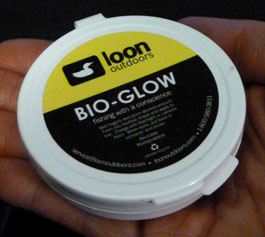
   Bio-Glow, produced by Loon Outdoors, is strike indicator putty that also glows in the dark when charged with a UV light or a regular flashlight.
 
OVERVIEW
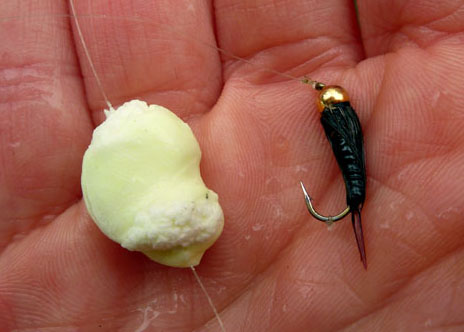
   This pale yellow product did not leave a favorable first impression.  I opened the lid and the Bio-Glow was stuck to the container’s top and bottom like freshly chewed gum sticks to a shoe.  When I removed the putty from the lid, that tacky stuff really stuck to my fingers and it was difficult to thoroughly get off my skin.  Furthermore, to float it on the stream I had to use larger diameter putty than the diameter of Thingamabobber I normally use.

   Sounds pretty grim, right?  Well, I actually started to like the material a little… then a lot.  Now I wish I’d ordered another 1-2 containers of Bio-Glow or its non-glowing sibling, Biostrike. 

   As the directions read, wet hands when using the material.  Do this and there won’t be sticky putty on your fingers!  Streamside, it worked beautifully.  Fingers wet, I pulled out the desired amount and pinched it around my leader.  Done.  If I wanted to slide it up or down my leader, I did so and pinched the putty down again.  Then, I got on with the fishing.    So very fast & simple!! 

   I did have to apply more Bio-Glow than I expected to need.  I pinched off an amount similar to the diameter of indicator I typically use.  The Bio-Glow sank.  I added a bit more and it floated for 5 seconds or so before slowly drifting subsurface (It still indicated fish this way & provided a slower fly descent..hmmm..).  Finally, I added a little bit more and the indy putty floated fine with my 5/32” tungsten bead-head sz 12 nymph and sz 18 dropper.  I did expect a heavy splat but that didn’t happen.  Was it a delicate presentation?  No, but it didn’t land much differently than casting with the other style of indy. 

   The single piece of Bio-Glow was my indicator for at least 2 hours before I lost it.  This timeframe included working my flies free from snags, and hooking, fighting and landing fish.  It never moved from its original position on the leader unless I moved it.  And unlike my plastic indicators or the foam ones others use, the Loon indicator putty is biodegradable!  The next day, I used the putty again.  Only fishing for a short time with an indicator, I removed and returned it to its container to be used another day.

   I have not fished with this material at night.  However, I ‘charged’ it with light and took pictures.  The initial very bright light dimmed quickly but left a good amount of glow afterward.  Even after 10 minutes a smidge of glow remained.  The autofocus light on my camera continued to recharge the Bio-Glow so I couldn’t accurately depict how much the glow decreased over time.  To use this at night in current, I’d estimate that its optimal use would be 2 minutes prior to wanting to charge it again.  In still water, I suspect 5 minutes max of fish time between needed charges.  I hope to do some night fishing in April and will update this post if I do.

RECOMMENDATION, MISC, UPDATES
   At this time, I recommend giving Bio-Glow ($7.95/1.0 oz) a try.  Just like anything, it may not be optimal for all situations but I think it will do the job - & quickly- in a lot of them.  It’s extremely easy to connect to and reposition on the leader & that increases actual fishing time.  It stays in place in most situations and is meant to be re-used.  If lost, it is biodegradable.  After moving the indicator, a small amount of residue remains on the leader but is easily removed.  If you like the idea of a putty indicator but don’t need it to glow, Loon Outdoors also makes Biostrike ($7.50/1.0 oz), which is available in a few colors.  Check out Bio-Glow at your local fly shop or click this link to visit the Loon Outdoors website:  http://www.loonoutdoors.com/products.html#bio-glow 

   How much bang there is for your buck simply depends on how much weight you have below the indicator & how much putty you return to the container after each fishing trip.  The container is similar in diameter to a tippet spool, but twice as tall.  A firmer container or slightly domed lid would lessen the inconvenience of the tacky putty becoming pressed against the lid.  I used Bio-Glow for the first time when air temperatures hovered between 35-40*F.  The product was also kept slightly warm as it was located on an inside pocket of my wading jacket.  I am very curious to learn how well it will hold up to Midwestern summer temperatures (& freezing winter temperatures) and if the ease of application will change.  I am looking forward to  using it again.  Over time, I suspect updates will be added to this post. 

PROS:
*Easy to use or to adjust up/down leader.  *Takes seconds to add to leader or to adjust.  *Remained in place on leader for prolonged time.  *Re-useable.  *Biodegradable & environmentally friendly.  *Compact container.  *Can glow in the dark. 

CONS:
*May need more putty than expected.  *Container design makes putty stick to lid.  *Possibly better chance to lose a putty indy than another style of indy.  *Cost/use may be a con depending on how much product is required for the individual’s needs & environment. 

Updates
3/22-23/13:  I used 1 Bio-Glow indicator for 1.25 days of nymph fishing.  I made another indicator after the original got lost from my line while I was bushwhacking through some pretty thick stuff.  Temps were ~31-35* (I had to break ice off my guides on day 1) and Bio-Glow did stiffen, causing me to take a tiny bit longer to remove from container & place on leader.  No big deal.  It also seemed to take a little less product to float my dropper rig set-up (less than I reported in initial review) and at one point I even had split shot on the rig.  Does it float better when colder or is it me?  Later in the trip, esp the next day, I did have to move the Bio-Glow back into position a few times as it had slid down to the fly.  Once I gave a little pinch-twist to the body of the indicator -not just the ends- it remained in place.  Again, it was colder, I'd been fishing with it for many hours, and I was fishing an area with beaver dams with higher silt content (Bio-Glow did pick a little of this up).  It was still much easier and quicker to use than regular strike indicators & I'm fishing more efficiently because of this.
12/2013:  If putty starts to accumulate on the exterior of the container or interior of the lid, it becomes difficult to open the lid of Bio-Glow's shallow container.

Wednesday, March 13, 2013

A Heap o Thanks for Making the 2013 HFFA Fly Fishing Show a Success

   The 39th annual Hawkeye Fly Fishing Show, held March 1-3, 2013, was evidently a darn good success!  I didn't get to our branch's Sunday meeting since fishing trumps meetings, but rumor has it that we were successful in generating a fair amount of funds for stream restoration in NE Iowa.  I also heard that the number of 'walk-ins' at the show was greater than expected and that the speakers were well-received.
  
   A public thanks goes out to fellow club members who put forth so much time and effort to make the show a success, as well as those people and businesses who donated items and services for the raffles and silent auction.  If you were one of the the lucky winners, please thank the merchants for their donations and tell them why you appreciated using their products or services!  Heck, even if you didn't win, if you know a particular business donated, tell them thanks the next time you visit the store.

   Thanks also to the tiers who donate their time, gas money, and lodging to share their knowledge with others.  As usual I spent money with the vendors and am always glad to see them.  They were also a very helpful and friendly bunch. Thanks!

   A club member had the bright idea of taping the presentations so other members who worked the show and didn't see the presentations could watch them at a later date.  I'm looking forward to a few hours in the near future of fly fishing tales, popcorn and beer.
 
   When I learn where some of the generated funds will go, I'll update this post.  Thanks also, to those who attended and filled the silent auction lists and the buckets with their tickets/contributions.  There would be very little funds for conservation efforts without your help.  Next year's 40th anniversary show is in Cedar Rapids.  I think it is going to be a primo show!!

Tuesday, March 12, 2013

A Perfect Iowa Blend of Trout, Rain, and Snow

   It was yet another great day to be out on the water.  Faced with not feeling well the previous day, I was grateful to wake up on Saturday, March 9, without a pounding head and with the knowledge that my friend, Jackfish Kate, was willing to fish at a moment's notice.  Thinking our planned weekend of fly fishing had been lost, we were still happy to hit the water by mid-afternoon.

   I'd received a couple of outdoor/fly fishing products in the mail recently and had been hoping for a rainy weekend to test out & review a wet/dry backpack.  Kate's and my curves land on opposite areas of the body and if we could be merged together, one might come up with the measurements of a Playboy Bunny!  So, I really wanted her opinion on the fit and comfort of the backpack - an item often designed with the average male in mind.  She was game & the review is forthcoming.

   We elected to fish Trout River, located southeast of Decorah, IA.  The next day we planned to fish N. Bear but those plans were thwarted by the potential of snow, ice, and wind.  Instead, we explored and fished Twin Springs, Decorah's urban trout fishery.  By Sunday, that stream was the color of milk chocolate, flowing high and fast.

   All fish were landed on Saturday and Trout River's water level was still low but certainly higher than last summer.  It was clear but not 'gin clear', as it had been during those warmer days.  As the day progressed, the water's cloudiness progressed as well.  Once again, I'm reminded that it was a perfect day to be out on the water!  We hiked in 10-12" of snow while rain lightly fell.  The fish were hungry and I had a decent amount of strikes on first casts.  The stream had not likely seen many recent fly angling visitors.
 

   Unluckily, I did not convert on many strikes that day and had a few 3 second fights which ended with finned winners.  I know Kate landed fish and I enjoyed watching her land her day's first rainbow at the same wide, slow hole where I had previously seen her land a trout on her first-ever day on this stream back in May.  I landed 6 fish total.  Unluckily & strangely enough, 3 were foul hooked on my sz 18 dropper.  I did not photograph the beautiful brown I landed in that manner.  Two rainbows, and my largest brookie to date all measured about 11-12 inches.  One bow was beautifully marked and the brookie, well, looked great like brookies always do.
 
   Conditions must have been prime, because these fish fought harder than I've ever felt them fight on this stream!  The bows hit my big nymph and the brookie went for the sz 18 scud.  All 3 fish had to be unwrapped from the dropper's tippet and one feisty fish managed to tie a couple of overhand knots in the tippet.  Later that night at a Mexican restaurant, Jackfish tongue-tied an overhand knot into a Maraschino cherry stem.  However, I think a twice-fin-tied overhand knot trumped her feat…

   On Sunday, after visiting Decorah’s Twin Springs and seeing the Upper IA River that it feeds into all in the same park, I’m already envisioning a multi-multi-species weekend this year:  pike, walleye, smallies, and trout!